Tuesday, August 28, 2012

Irony and the Language of Faith


Last week J and I were involved in a tragic car accident in the mountains of New Mexico.  One of the bikers who hit us was killed.  It is a horrible experience.  I don’t blame either our driver or the cyclists because it was one of those accidents that just happen.  I had planned this post to be called “S**t Happens!”  But with the death of one of the 6 of us who are inextricably linked for the rest of our lives, I don’t care to be glib or humorous about such tragedy.  I mourn for the young man and his family and friends even though I never knew him.  I ache with the woman who was also badly injured.  Such incidents scar one’s life forever whether the scars are visible or not.

On the way home from NM, we blew a tire only about an hour from home.  While waiting for roadside assistance, a car stopped and man in biker attire got out and changed our tire.  He wore the typical biker’s leathers, multiple tattoos, jack boots, do-rag and a vest with a prominent cross on the back.  He was a member of the Christian Biker’s Alliance, he said. We chatted as he did his ministry to us talking about biking and faith.  His was a bold faith that said he didn’t believe in helmets since he knew he would live forever in Christ.  He said that he drove too fast for a helmet to do any good anyhow.  In a matter of about 15 minutes he had changed our tire and had deeply affected my understanding of trust in God. 

I am always moved by the faith of others.  God touches us in such different ways.  The biker’s theology is quite different from mine.  For me life is precious and a gift from God to be protected and cherished.  For this man, his life is not something to be preserved but lived to the hilt with little regard for the dire consequences of living on the edge.  It was a sobering intrusion into my neatly constructed faith circumscribed with prayer books and liturgy.  I have no doubt that his theology worked for him and for his family (his very un-biker wife waited in the car during his ministrations).  But I couldn’t help but think that this was a kind of faith that I could not subscribe to but could not deny that it was rooted in that awe and experience of a Holy One that was as powerful as mine.

Since that incident I have been trying to look at my own faith and the faith of those throughout the centuries that have been unshaken in the face of death.  I think of those who go into combat in the name of Christ—from the time of Constantine, through the knights of the Crusades or perhaps the One Hundred Year’s War over religion that changed the face of Europe and brought cleavage due to one’s faith rather than territorial boundaries.  I am deeply aware of the irony of ‘soldier’s theologies’ that has ‘marching off to war’ as a primary sign of fidelity to Christ, the Prince of Peace.

Why is it that faith in God often demands our death in order to experience life to the fullest?  Certainly Christianity has been taught that way at certain moments of church history.  But need it be that way?  Does faith in God demand extremism in order to trust God’s salvific promise?  Does faith demand crucifixion in order to image the love of God?  Or in another way of asking it: Is the Christian faith inherently violent?

The God that I experience in both prayer and worship invites me to rest, to pause in the midst of life and know the irenic when all around me is whirlwind.  It is not polemic where God is.  It is the still quiet voice where the Divine touches rather than in the wind in the hair or the exhilaration of a battle fought and won.  And it is the place where God is that demands of me the kind of examined life that returns me to peace and the absence of argument.  I cannot be what God calls me to be if I cannot allow myself to know the kind of peace that God is.

As I delve into the ways we have talked about faith for centuries, the more I recognize the language of feudal fealty in worship.  We have ‘bounden duties’ and we talk about the interplay of good and evil as knightly jousts.  We even express Christ’s renewal of Creation as salvific rather than a return to the peace that humanity often destroys. 

Perhaps a new language of relationship and peace needs to be developed rather than with such medieval words.  We need not “fight the good fight with all of our might” but learn how to describe the wondrous harmony of love.  We need a new vocabulary to describe that place where God abides in us and the goodwill that we have forgotten in name of action and ‘doing Christianity.’  We need to find a way to describe the tranquility that God engenders in us for the sake of the future of humanity.

May the souls of the departed rest in peace.  Amen

Monday, August 20, 2012

Dancing with the Holy

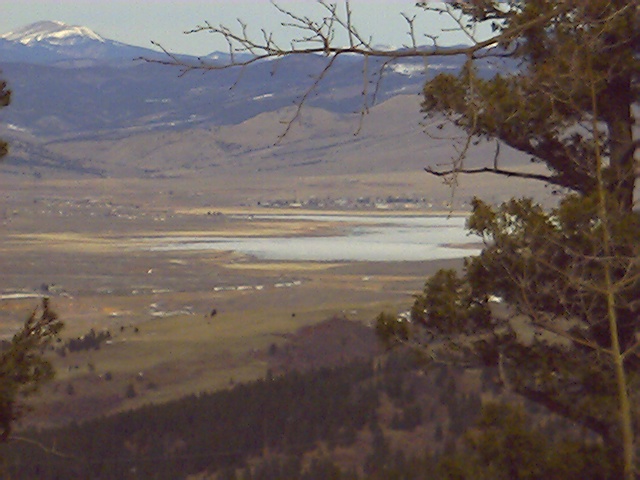
This is where I am staying.  I got up and went fly-fishing today.  I should amend that to say 'fly-casting' because I was able to ascertain that my fishing muscles could still remember the casting motion even though the muscles are not quite up to  long periods of use.  I am still capable of really snarling a fly line beyond the place of use and I can still hook the seat of my pants.  So all is right with the world.

Retirement it a holy thing.  It allows one to recognize failure but not get overwhelmed with having to fix it.  Normally I would have spent the rest of the afternoon trying to correct my form and bring those flabby muscles into line.  But today I am content that I have gotten to reacquaint myself with old joys and beautiful scenery.  I can come home without fish and bask in the simple pleasure that 'I've still got it' and on the next time out I will be able to cast to those pesky trout without scaring them.

Last night again we heard a concert from Music from Angle Fire.  We had decided that we wouldn't go the 45mins. away to go to the nearest Episcopal Church.  The service was way too early for vacation.  We didn't go to the local unified church service either.  But the music presentation was Joseph Hayden's The Seven Last Words of Christ from the Cross.  We heard it in its string quartet form.  The concert was held in the local unified church set facing the mountains.  The concert began at dusk and the  musicians had only their desk lamps to lighten their music.  As the sun fell gradually the church--a beautifully simple open clear glassed building--darkened with the hues of the sunset.  The shadow of the cruciform timbers of one side of the nave shadowed cruciform shapes upon the clear glass of the other side of the building.  The performance was clearly "Church" for me.

The music was somber and moving.  It was designed to support the service of "The Seven Last Words" interspersing the last words of Jesus upon the Cross.  I have done the Seven Last Words service on Good Friday many times in my career but never have I heard these particular interludes.  Hayden, the originator of the string quartet, used his vast talent to bring such a momentous event to life with his music.  Program music, that music that tells a story, is really not a concept until the late Romantic era, but in Hayden's Classic-era sonata form, the Passion is experienced without comment save the Scriptural passages themselves.

It has always been difficult for me to understand which came first in my faith, music or relationship with the Divine.  I think that music was the vehicle by which I came to know the reality of God. But one does not come without the other.   I remember in my 20's making the distinction between performing and offering my music as gift to the God who made the making of music possible.

For me there is a dance with the Holy that takes place when I write, or compose or play music or teach or preach or cast for trout.  I do not dance.  I am not one who learns the steps to music or gaily trip the light fantastic.  My body is not one that easily can follow another's lead.  And I have often felt this was a sad deficit in my life.  But the dance I have learned is the dance of faith that entertains the holy and the mundane so that it creates a holistic involvement of body and mind and that whatever it is that we often call a soul.  And while I can't get my body to always embrace the actual dance steps, the mind will compensate as the heart is filled with this aggregation of the learned and practiced with the spirit of the moment that creates moments of utter bliss.

It is these moments of utter bliss that I experience as the presence of God.  And it is these moments that I savor as the revelation of the Divine One, the Creator.  It is this Creator that deserves my worship and praise.  It is this Holy One that not only reminds me of my humanity and mortality, but also reminds me of my call to Divinity and immortality.  And when in the liturgy we hear "Do this in remembrance of me" I recognize that relationship in that remembered bliss.

Yesterday we toured the Taos Pueblo, the longest continually inhabited area in the history of the western hemisphere.  I am intrigued by their culture and especially their faith which they guard from the prying eyes of those who would like to find fault with it.  It is only through the visual art do you get a hint of the depths of their relationship with the holy in their lives.  Even thousands of years ago, these people knew the beauty of Creation and set their living and worship in the center of that beauty. They absorbed the trappings of Roman Catholicism without losing their respect for their own kachinas or fetishes and talismans.  They still create pots, jewelry and carvings with the designs of these powerful totems as offerings just as surely as my music was offering to the God I recognize in my dance.  Even today, the Indians find such fulfillment in the dances of their people and the vocabulary of their unwritten language.  The recognize that their dance with their Creator is just as demanding of them as I see in the message of the Passion, or the celebration of the Eucharist.

I am ashamed of what my faith has done to theirs in the name of 'civilization.'   I am heartsick with the loss of the possibility to share what is holy together because of the acts of my people.  And I can only stand at the door of their culture and respect the dance they have made over the past 500 years to maintain a culture that reveals goodness, care and love in the face of oppression, slavery and ignorance.

Perhaps it is this that makes my dance with the Passion of Christ, my dance with the trout line, the way of the Tiwa all significant.  It is all about the remembrance that we are related, we dance different steps but to the same music--the music a Creator God instills in our hearts.  


Saturday, August 18, 2012

Dancing with the Muse


It has been a while since I have written.  When life gets hectic one’s writing goes to hell.  But presently I am on vacation.  I am in the NM Mountains enjoying delightfully cool mornings in jeans and fleece and contemplating going fly-fishing this evening.  It is the first real vacation that we have had since we moved to TX. 

Angel Fire was not a destination the last time I was in the NM Sangre de Cristo’s but it certainly is now even in the summertime when musicians from all over avoid August heat, come to perform and practice.  When I was involved in the music scene during my teens and twenties, musicians often came to Taos or Colorado for the summer to perform in summer musicals or performance series for those who also fled the heat or the locals who didn’t get to enjoy such music.  But the chamber music series I attended last night was far beyond those days.  These were East Coast teachers from Julliard, Curtis and the like, performing in a concert series that blew me away.  It was the highest quality of performance that I have found outside of New York City or San Francisco. 

We gathered in a community center with folding chairs and basketball hoops hanging overhead, but with good lighting and a decent stage with a full-sized Steinway.  People in western attire—obviously summer dwellers, mostly over 55 sat enraptured by soloists and string quartets while the lightening of a mountain storm played outside. 

The muse began to loosen listening to Poulenc and Faure.  I am generally not drawn to French music, but this concert was different. The works themselves were delightful, rich with harmony that I generally don’t associate with French post romantic.  But it was the sheer musicianship of the performers and participating in their delight in playing that began to open some creative blocks in me.

I am visiting with a friend who is an artist.  She commented that such music performance loosened the muse for her too.  There is something about the beauty of the mountains and the cool nights, the specter of bears through the trees and nights when the stars seem close enough to touch that allows one to speak of the things that are Holy.

Painters, musicians, composers, authors-- artists of all kinds touch the Holy.  It is why the Greek Muses were considered gods.  It is when all one’s talents come into the presence of the Creator that we may create.  And it is that creation that motivates others to create, produce, or perform.  It is contagious.

God as Creator invites humanity to emulate God’s work.  Most musicians know when they are ‘in the zone’ just as readily as a basketball player.  Most painters know when they have been touched by the muse and so do sermon writers or bloggers.  Talking with another guest, I find that doctors have this same high when working with their patients.  I know I used to have it when I found a way to teach kids who weren’t getting it in class.  That is what I speak of when I ‘enter the Holy’.  It is the finest that I can give, it is the finest that I can conceive at that moment. It is the finest I can produce. It is the moment when ‘God and man together have sat down.’

 In my experience there is always mutuality in creating.  There is a reciprocity in writing, composing, painting, performing—a give and take to a process that from the outside appearance looks highly individualistic. But my experience is that there is always something or someone that is part and parcel of that creation. 

It can be a maddening compulsion, art. And at times it becomes a frustrating job trying to complete it when it is right.  Creativity is as much a part of me as breathing, and I believe that is true for most people who take seriously the work they do.  Creativity is as important to the farmer as it is to the painter.  It is as important to the techie or engineer as it is the musician.  They manifest themselves in different ways.  I even believe lawyers whose work is to always ‘color inside the lines’ find a type of creativity when they find laws by which their current issue can be addressed.  Scientists must be creative to understand the world about them. 

Most of the time I am writing to the reader, but there are times when I am writing what someone beyond me needs to be spoken.  Some would call that the Unconscious; I know it as something beyond the me-ness of my unconscious.  I often surprise myself with the words that emanate from my keyboard. 

All of this experience of the author of the creativity is beyond me. I call it, for the want of a better term, God.  It is the only way that I can speak of this entity that doesn’t sound like Star Trek or New Age mumbo-jumbo.  But it is real.  I experience it all too often not to recognize it as that which the great spiritual writers of any generation or tradition describe.  So many years ago I dubbed this marvelous acquaintance ‘God’ or ‘Holy’ and leaned into a tradition and a history of those who spoke of this God through the eyes of Jesus.

Do I believe everything that Christianity proclaims is truth?  No.  Do I proclaim all the doctrine of even my own denomination as holy?  Probably not.  But I have found that in Christianity I have found a way to proclaim the goodness of this God.  I have found in the embrace of this Divinity the dance with the muse.  It is a muse that allows me to proclaim goodness and to discourage evil.  It is a form of creativity that allows me to be in step with my Maker.  It allows me to invite others into the dance.  Sometimes it just allows me to sit and drink all of the creativity around me. And I can reach for the stars, breathe pine-scented air, listen to exquisite music, feast on home-made bread, and look for rainbows in snow infused streams.  And as one of my fly-fishing friends said, “I know where God goes on vacation!”

Monday, August 6, 2012

A WoW Sermon from Susan Russell


This one is well worth listening to.  Susan lights a fire under me all the time.


http://www.youtube.com/watch?v=PiZG7tsWJTs&feature=colike

Monday, July 30, 2012

Something is rotten in the medical industry.


I have been grumping about this for a few weeks now and now am ready to rant.

Sometime in the past decade the medical ‘profession’ changed from being a profession into an industry.  I had had the same doctor in NY for 10 years so I didn’t notice it until I came to TX.  Now, I am aware that TX is a ‘business state’.  It is a state in which businesses are considered persons and the corporate fervor that has invaded the economic system of the USA is writ large.  But the whole issue of health care is problematic here.

First of all, it is almost impossible to find an established doctor who will take Medicare as primary insurance.  And since Medicare doesn’t allow the retired to use it as secondary from the get-go, seniors find it difficult to follow their grandchildren to the great state.  Secondly, when you call a doctor for an appointment, you must provide information about your insurance first.  There is no question about your ailment, your disability, not even your name.  You are asked for your birth date before anything else so that they can tell you that they don’t take Medicare.

Doctors and dentists now want to be paid BEFORE they examine you.  Dentists, especially.  Then before even seeing you they take x-rays, or do blood work before they even know what is wrong.  They evidently think that the tests will tell them what is wrong.  What’s wrong with just LISTENING TO the patient?  But doctors are no longer professionals.  They are employees or extensions of Insurance and Pharmaceutical companies.  Today, your doctor does not even know your name unless it comes up on the computer in front of them.

Many years ago when I started teaching, the teaching endeavor was considered a profession.  Teachers were respected as people who cared for the children of a society.  But somewhere in the early 70’s teaching was organized, first by the NEA and then unionized.  They began collective bargaining and the profession was denigrated to that of Labor.  What once was a noble profession became a mechanical job of baby sitting with lots of papers to fill out.  It was no longer the work of the teacher to challenge young minds.  It became a job that taught to tests and teach by rote.

The medical profession used to be filled by noble men and women who cared about the people that came to them.  They were a respected part of the wider social community and people you could turn to when there was someone in need.  Here in TX I have encountered doctors who take great delight that they only work 3 days a week for a corporation that says that you can only meet with your patient for 10 minutes.  They like driving their Benz or Jag or their Escalade, and visit their summer homes in Jackson Hole or the Bahamas.  They spend more time on the golf course than visiting their patients in the hospitals.  Most primary physicians here do not even have hospital privileges; they turn all hospital issues over to ‘hospitalists’.

I know that the medical profession has changed over the years and the cost of healing has skyrocketed, but why?  England and Canada do not have this problem.  We hear stories from pundits that they have horrible systems, but why then would the UK express the health care system in the opening of the London Olympics?  Everyone I have ever talked to who has experienced their systems, except doctors, appreciate the care they have been given.

I don’t know why I must pay for lavishly decorated doctor’s offices?  I don’t know why I must pay for the plastic giveaways that accompany every hospital visit?  Everything that touches a patient nowadays is plastic and goes into landfills.  And there is no more prevention from infection now that before the plastic era.

All I want is to talk face to face with my doctor about whatever is ailing me and for them to find a way to fix whatever I have.  Some illnesses (like growing older) you can’t cure, but you can learn to live with.  I have asked for ways to deal with some of the things I have and been told to look it up on line. 

What is happening to medicine is what happened to teaching.  The teachers became employees—became staff no longer professionals.  They lost their ability to meet with the parents of children.  I remember my principal in the early 70’s castigating me because I went to the home of one of my Hispanic children and talked with the parents.  The principal did not what to have to deal with ‘those’ Spanish-speaking parents so that they could get free lunches.  When teachers became robots of the school system or doctors become minions of insurance companies there is a loss of the whole of the profession.  No longer are the teachers considered part of the fabric of the community.  No longer are doctors considered the wise souls of the town.  They are formed by the almighty dollar and healing goes out the window. 

As a priest who has known both the experience of being a professional in the community and now experiencing the whole destruction of the Church, it is hard to know where to turn.  I am quite sure that the Texas medical environment will eventually lead to socialized medicine because it is too hard for the poor to access any care whatsoever.  Somewhere, somehow, a conscience will rise up to show us the Lazarus at the gates of our hospitals and dental schools. Maybe a squadron of Mother Theresa’s Sisters of Charity will have to come to TX and they did in Calcutta.  The government will be the only thing big enough to quell the avarice of the AMA.  If they continue this line of thinking, the US will have no choice because the sick will line our streets, rather than be healed in our hospitals.  When the relationship between patient and doctor, teacher or priest is lost, the glue that holds our communities together falls apart.  There is nothing that demands that we know one another, have concern for each other or even respect each other.  Something is rotten in the medical industry.  

Saturday, July 21, 2012

Building Church


2 Samuel 7:1-14a Ephesians 2:11-22, Mark 6:30-34, 53-56
We have some interesting readings today.  The first reading has to do with King David’s image for a house of the Lord.  David moves from being a shepherd to becoming a warrior and a king of Judah.  When he finally rests from his warrior ways and decides not to return into that nomadic tent-living existence and settles into fine living in the city of Jerusalem.  He has conquered not only the Philistines and Goliath but has gone on to invade the stable agrarian communities around him.  He is now living in a fine home, no longer living at a substance level.  It is nice.  He can smell the rich, sweet smell of the pine wood of his home rather than the dust of tent-living.  And he thinks of God who is still “living in a tent.” 

Since the time of Moses, the God of Israel was worshipped in a tent.  And like religious institutions the world over, the priests lagged behind because of tradition.  I am sure that the sons of Aaron had been just as unwilling to change things as many vestries I have had.  But David had a vision of providing for God a house—a temple.  As we all know, it was not David who built God a temple; it was his son Solomon who built the 9th century BCE First Temple.  But we hear David’s vision here in this passage from 2nd  Samuel.

The building of religious buildings is an amazing endeavor.  Some of your founding members may be sitting here.  I remember when Christ the King was moved from out in the country to its present place.  It implies permanency.  It implies strength of purpose.  And yet…and yet…  We know that no church building says anything about faith, the honoring of God, or the proper living of God’s commandments.   Buildings do not last or stand forever.  But it is faith that lasts.  Gradually the Temple that was built by Solomon was to be a worship place for all the nations.    But over the years the Temple was restricted to only certain select persons, those who were circumcised, those who followed specific cultic strictures, those who ‘fit in’ were allowed to enter into the Temple.  By Jesus’ day, the Temple began to be restricted to those who were circumcised.

In the Epistle, Paul is writing to the people in Ephesus to remind them of whose they are.  He is trying to bridge a major division in the synagogue between the circumcised members of the community and those who were called ‘God Fearers.’  In the couple of centuries before Jesus, Judaism had become a proselyting faith.  People who were not ethnically Jewish came to Judaism because of its monotheism and its clear ethical precepts.  In those communities farther away from large ethnically Jewish locals, the synagogues were often as much as half-Greek speakers as they were Hebrew or Aramaic speakers.  Most Greeks saw the body as beauty and found the whole idea of circumcision as repugnant.  So there was a division between those who had been circumcised and those who followed the Law of Moses but were not circumcised.  Paul is writing to the church in Ephesus to say that circumcision is not what is important.  Peace is what is important.

Now this is an important concept because in Roman Imperial talk, it was Caesar who brought peace. The Imperial propaganda was always full of how Caesar was  the god who brought peace.  Paul is saying that is the love of God that brings peace in terms that were not only fresh but slightly treasonous.  The ones who were ‘once far off’, those who were not ethnically part of the Chosen People, were brought near through baptism. It is the love of God that has brought these once foreigners are now part of the body of God’s chosen.  This is language that was really only reserved for the head of the Empire.  But Paul makes the case that  Jesus is who makes them one.  It isn’t Caesar who makes them citizens.  It is God who makes us one body, one nation, one people with access to the Temple.

Paul’s theology about circumcision is the first theological argument of the Church.  It is found in Acts of the Apostles how Paul and Peter argue about the place of the ‘God fearers’.  But Paul argued that God is universal—that access to the faith was to remain always mixed and varied. And that it is the power of the relationship with the Holy One was what made it possible to know that humanity could know peace without having to be alike.  Baptism became for the church the sign of our unity in God.

In our Gospel today, we find Jesus being hounded by those who wanted to sit at his feet or have them heal them.  Jesus understood the need for personal prayer, the need for solitude or quiet to rejuvenate his ability to share God’s love.  We often think that the pastoral life of Jesus’ day was not as hectic as it is today.  In between these two pieces of scripture is the feeding of the 5,000.  So it is not surprising that people would follow him just to sit at his feet.  Jesus was a super-star, but more than that.  Jesus had a message of peace that rang authentically, something that was unfamiliar in the religious practice of his day. 

 I hear a real message to build the Church in our own day.  I hear a call from these passages a charge from God to provide a house for God that may not be made of the cedars of Lebanon but made to serve a world that is more conversant with computers than they are with their neighbors.  I hear a message of peace that says that we as the Episcopal Church is unwilling to exclude the ‘different’ just to make us comfortable.  I find in them the call to self-reflection to claim what is authentic in the words of Jesus and to live them out.  I drink deeply of the scenes of each of these passages and find myself trying to figure out just how I am to assist in the visioning of a new Church for an era that we can’t even understand.

I sat in a Diocesan meeting yesterday listening to those who are just as confused about how we are to plan for the next 3 years as you are.  Are we going to have a house for God? Or are we going to spend yet another year praying out of our box?  Are we going to be able to be at peace if we get our church back or not?  Are we going to have money to do this or that? What are we to do when our priest is ill?  Are we going to be able to find a place of relationship with the Holy One of Israel?  And most of all, where can we find a bit of solitude to know Jesus a bit better?

These lessons speak loudly for us today.  They call us to drink deeply of the peace that God holds out to us in the word, in the Sacrament, in the community of faith and in those moments alone.  We want to make this ‘house of God’ we are building to last—maybe it won’t be of bricks and mortar but of the substance that allows all to find Christ in it.  We are building a new church just like David—it is a vision needs to be spoken.  It is a vision that needs to be shared so that when it comes time for our children to rebuild—or our children’s’ children to rebuild, the peace that Christ calls us to will be found.  It will come from our steadfast holding on to the relationship with Jesus to direct us.  And most of all, are we willing to be that Church?

Will we ever be as strong as we once were?  Will the Episcopal Church still be the bastion of a certain social-class?  Will the Episcopal Church once again have the influence it had in the 1970’s?  I hope not.  But hopefully we will have found a way to live the authenticity of faith as followers of an itinerant rabbi in Galilee who had the audacity to teach love, peace and community to the Roman Empire.  May we become the kind of followers of Jesus whose message is that it isn’t the building that makes us Church.  It isn’t the doctrine that makes us Church.  It is the love of God that is shown to the world by us that makes us Church.  AMEN

Thursday, July 19, 2012


The Reverend Gay Clark Jennings is from the same parish in Syracuse, NY that I come from.  She has just been elected as the President of the House of Deputies, a position that she is more than qualified for.  She has been in charge of CREDO for the past several years and before that was Canon to the Ordinary in the Diocese of Ohio.  I knew her parents well even though Gay had already been ordained by the time I knew them.  This post at the Washington Post is her first as PHOD and a response to the disgusting op-ed pieces from the NY Times and the Wall Street Journal.  My prayers will go with her for the next 9 years.  It is not an easy job to be in charge of the HOD but it is an important one.  We will be well led.


Episcopal churches: Short on politics, sexuality debates and long on Jesus


Bishop Mariann Edgar Budde, Washington's first female and ninth Episcopal Bishop, smiles during her consecration service at the Washington National Cathedral Saturday, Nov. 12, 2011. (AP)
Every three years, the Episcopal Church lays itself open to criticism and ridicule by gathering about a thousand people together for eight days and thinking out loud.
The people at our General Convention come from all over the church, which includes nearly two million people in 16 countries. The topics we discuss also come from across the church: it’s relatively simple for Episcopalians to submit resolutions for legislative consideration. The result at our recently concluded gathering in Indianapolis was that the world was able to watch us debating issues including the blessing of same-sex relationships, peace in the Middle East, and whether dogs have souls.

Our bicameral legislative structure was borne of the same revolution against England as was Congress, and we look alike. It’s easy to stand on the outside and view our democratic process with the same disdain and cynicism that voters feel toward what transpires on Capitol Hill, or to assume we’ve sold out our faith in favor of the secular world.
I believe these criticisms are misplaced. Episcopalians are remarkably sincere about church democracy. We believe that the Holy Spirit is working through our legislative committees and debates, even when we misinterpret her guidance. Part of the reason our General Conventiontakes so long is that we spend significant time in worship, reading scripture, and singing.
When things get rough or tempers flare, we usually take a break to pray together before resuming debate. If we need more time to discern where God is leading us, we take it. Our recent moves to include lesbian and gay Christians more fully in the church, for example, are the result of more than 30 years of theological study, prayer, and conversation. One can disagree with these initiatives, but they were not born of a desire to reject our Christian truth for secular wisdom. Many of us who hold quite traditional views on the nature of sin believed that our church needed to repent of the sin of homophobia.
My mother used to say that the church’s only problem is that it is riddled with human beings. Our big, public legislative process puts all of our human frailty on display for critics and cynics to gawk at. Like the previous two thousand years of Christians, we’ve got colorful characters and prophetic voices, and it’s not always easy to tell the difference. God is still speaking, as the United Church of Christ likes to say, and sometimes doing so in voices that make us uncomfortable. I don’t suspect anyone would have been happy to see Martin Luther or St. Francis of Assisi standing at a microphone at the end a long legislative day, ready to offer their detailed objections to the way in which the church was doing business. Yet, clearly, the church would have been poorer had it failed to hear them.
Enduring occasional mockery is a cheap price to pay for a church that elects its leaders and recognizes that lay people, clergy, and bishops must share decision-making authority in the church. Unfortunately, it tends to obscure what actually transpires at our General Convention.
The most significant legislative action we took in Indianapolis was a unanimous vote to begin reorganizing our church to meet the challenges of preaching and living out the Gospel in a rapidly changing society. Led by people like the Diocese of Washington’s bishop, theRight Rev. Mariann Budde, we are ready to spend the next three years flattening our hierarchy, streamlining our governance, and creating a budget that will keep more resources in local congregations and communities. A surge of enthusiastic Millennial and Generation X leaders is accelerating our shift toward flexible grassroots networks and away from a corporate model that no longer fits our focus on local mission.
It might disappoint sensationalist critics, but Sunday mornings in most Episcopal churches are short on political rhetoric and debates about sexuality and long on Jesus. Episcopalians are devoted primarily to praying together, serving people in need, and wrestling with hard questions that don’t have easy answers. We value Christian community over lockstep liberalism or any other ideological position, and even though it opens us to ridicule, we keep inviting everyone to join in.